


October 9, 2026
Why the weather will decide power and gas prices this winter – and why the risks are asymmetric
ca.
7
min read
Why the weather will decide power and gas prices this winter – and why the risks are asymmetric
The energy market is busy discussing LNG flows, terminals and geopolitics. What most scenarios leave out is the variable that can actually tip the winter: the weather. Looking at the spread between the coldest and the warmest winters since 1980 shows that the risk distribution for gas and power is anything but symmetric right now – and why a passive procurement position can become particularly expensive in this situation.
The underestimated variable: a 160 TWh spread between a mild and a cold winter
Almost every public market report treats the weather as a given – usually as an average, rarely as a risk band. Robin Girmes, founder of Energy Weather and a long-standing meteorologist at RWE Supply & Trading, put this into clear perspective in our October webinar: between the coldest and the warmest winters since 1980, Germany shows a temperature-driven consumption spread of around 160 TWh. That is more gas than is currently stored in German storage facilities.
This number is not a theoretical exercise. The coldest reference winters – the early 1980s and the mid-1990s – are some time ago. But winters like 2010/2011 or cold spells of the “Beast from the East” type are historically documented and meteorologically possible at any time. What matters is not how likely the extreme case is, but how sensitive today’s storage system is to deviations from the normal path.
And this is exactly the problem: the starting conditions for this heating season are worse than in any year since the war began in 2022.
Low injection rates, a low starting point – a fragile system
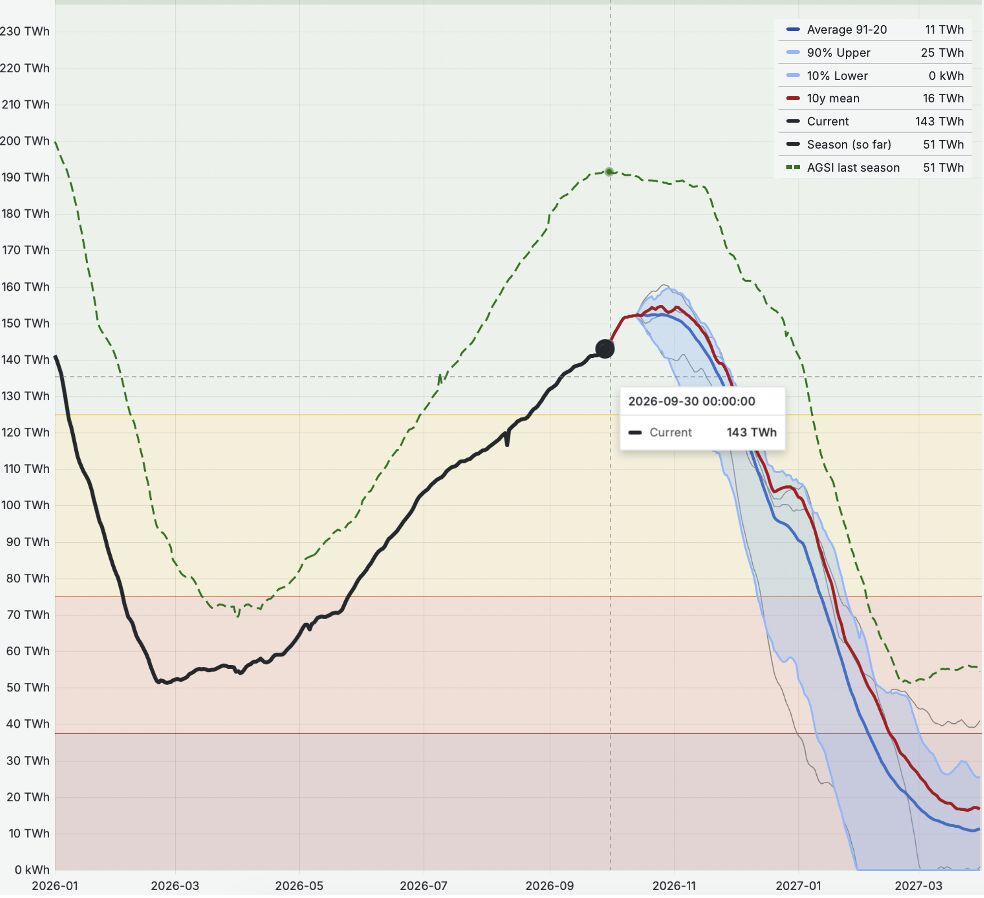
German gas storage is currently at a level that is higher than the EU minimum values under discussion, but clearly below last year’s levels and even further below 2024. More important than the absolute figure, however, is the dynamic: injection rates are historically low. Instead of the roughly 0.3 percentage points per working day that are usual in normal years, the change is currently around 0.07 percentage points – despite warm weather and practically no temperature-driven demand.
Put simply: even under ideal conditions, the system is barely building up a buffer at the moment. Under the current assumptions – industrial demand at last year’s level, German LNG terminal utilisation at a realistic 61 to 62 percent, continued exports towards South-Eastern Europe and Ukraine – the following storage levels result for the end of the heating season:
In a very mild winter (pattern like 2023/24): end level of around 20 percent. That is even slightly below the exit level of last winter.
In a winter along the ten-year average: end level of around 7 to 8 percent. A week ago, the calculation still showed 8 to 9 percent – the weak injection rates reduced the buffer further within days.
In a cold winter with an intense cold spell (Beast from the East or a comparable situation in late winter): storage runs empty on paper before the winter is over.
For context: last winter drew around 140 TWh from storage – starting from 190 TWh. The volume currently available roughly equals the consumption of a single normal winter. A cold winter would consume more than is currently stored.
Not all winters are the same – timing matters too
A second, often overlooked point: the course of the winter matters at least as much for price formation as its average temperature. The last ten years show that the period from mid-December to early January in particular has become systematically milder. Late winter – February and March – on the other hand has tended to become slightly cooler.
This has two consequences for the current winter:
A mild start lulls the market. Low spot prices in December create the illusion that the risk is behind you. In fact, February and March decide whether storage still has reserves.
A “Beast from the East” situation in late winter hits the system when the buffers are at their thinnest. Wind adds to the effect – because wind and temperature are strongly correlated, little wind in these periods often means more cold and less renewable power generation at the same time.
For the power market, this makes a second problem worse: in exactly the hours when gas, as the most expensive generation type, sets prices via the merit order, the wind is often weak. Every hour with solid wind feed-in pushes gas out of price formation. Without wind, the gas price passes through to the power price almost 1:1.
From price risk to availability risk
Translating gas into power only works as long as gas is physically available. That sounds obvious, but it no longer is. In early October, Spain shut down around 1.7 GW of industrial load because gas-fired power plant availability was at a record low. That is no longer a price signal but a physical signal – and it shows where things can go when buffers become thin.
The same applies to the export dynamic towards South-Eastern Europe. Because of Russian attacks on its own gas infrastructure, Ukraine holds lower storage volumes and draws from the Western European system over the winter accordingly. These export flows are politically intended and cannot be reduced in the short term. They put additional pressure on the German storage balance.
What matters for procurement: a cold wave does not happen locally. It typically hits several countries at the same time – which means that at exactly the moments when Germany would need import support from France, the Netherlands or Italy the most, these countries have the same problem. The idea that you can always import does not hold up in practice.
The key message – the risk distribution is asymmetric
What does all this mean for the energy procurement of industrial companies? The most important insight is not that the winter will certainly be cold. Nobody can seriously forecast that today – October is too early, meteorologically, to reliably assess the circulation patterns for the core winter period. Historical correlations, for example with El Niño events, are relevant for Southern Europe and North America, but close to zero for Central Europe.
What matters is the asymmetry of the consequences:
If the base case materialises (a mild to normal winter, orderly LNG flows), controlled waiting costs relatively little. Front prices – gas at around 32 EUR/MWh at the top end, above the fundamental range, and winter power baseload between 160 and 175 EUR/MWh – would tend to come down. In an easing scenario, gas levels of 25 to 28 EUR/MWh are conceivable, and German baseload could fall towards 150 to 160 EUR/MWh.
If, on the other hand, the cold scenario materialises – or even just a phase of intense late-winter cold – an open position loses disproportionately. For gas, spikes well above current levels are realistic, and for power baseload, values of 190 EUR/MWh and more. On top of that comes the risk that the effect carries over into calendar year 2027: if the 2027 injection season starts from an even lower level, the forward market for 2027 and beyond follows. Gas calendar contracts for 2027 are already trading at 43 to 45 EUR/MWh – trending towards 50 to 55 EUR/MWh. In August, they were just above 40 EUR/MWh.
This carryover dynamic is the real reason why the market is currently not only pricing winter 2025/26, but also carrying the problem forward into the following years.
What this means for procurement strategy
An asymmetric risk distribution cannot be hedged with a symmetric procurement strategy. In concrete terms: one-off decisions – “cover everything now” or “wait completely” – are particularly risky in this market phase. Both options implicitly bet on a specific scenario and ignore that the loss function is steeper in one direction than in the other.
What works in the current situation is a structured approach with three elements:
First, clear volume planning that staggers the portfolio build-up over time and ensures minimum coverage at defined points in time. This prevents a single market view from determining the entire position.
Second, a defined hedging corridor, i.e. a tolerance band around the planned coverage path within which you can deliberately react to market movements. If the corridor is too narrow, you lose the chance to take advantage of opportunities when the market eases. If it is too wide, you lose the risk limitation.
Third, clearly defined triggers that describe which market movements within the corridor actually lead to a trade – supported by technical indicators and algorithmic signals that are applied consistently over time. This replaces the discussion “Is now the right moment?” with a systematic decision logic.
For companies with a relevant residual load after hedging via PPAs or on-site generation, a fourth element comes into play: regular mark-to-market valuation of the remaining open positions, including the hedging effect of individual PPA instruments. We have described this approach in more detail in our article on BESS in industrial use and our article on systems thinking in the energy transition – both show why individual instruments only deliver their hedging effect in combination.
Conclusion
The current market is not only pricing the here and now, but the transition into a winter with historically low buffers and weak injection rates. The range between a mild and a cold winter exceeds the physical reserve of the system. For power and gas procurement, this means: the loss function of an open position is much steeper on the upside than on the downside – and a mild December is no all-clear for February and March.
Companies that get through this winter well have reflected the risk asymmetry in their own procurement strategy: through a staggered portfolio build-up, a clearly defined hedging corridor and systematic triggers instead of one-off decisions. If you would like to assess your current portfolio against this background, onu.energy supports you with an individual analysis of your procurement situation and transparently shows the sensitivities across different winter and market scenarios.
