



April 23, 2026
Why mid-market energy procurement no longer works the way it used to—and what actually helps
ca.
6
Minuten Lesezeit
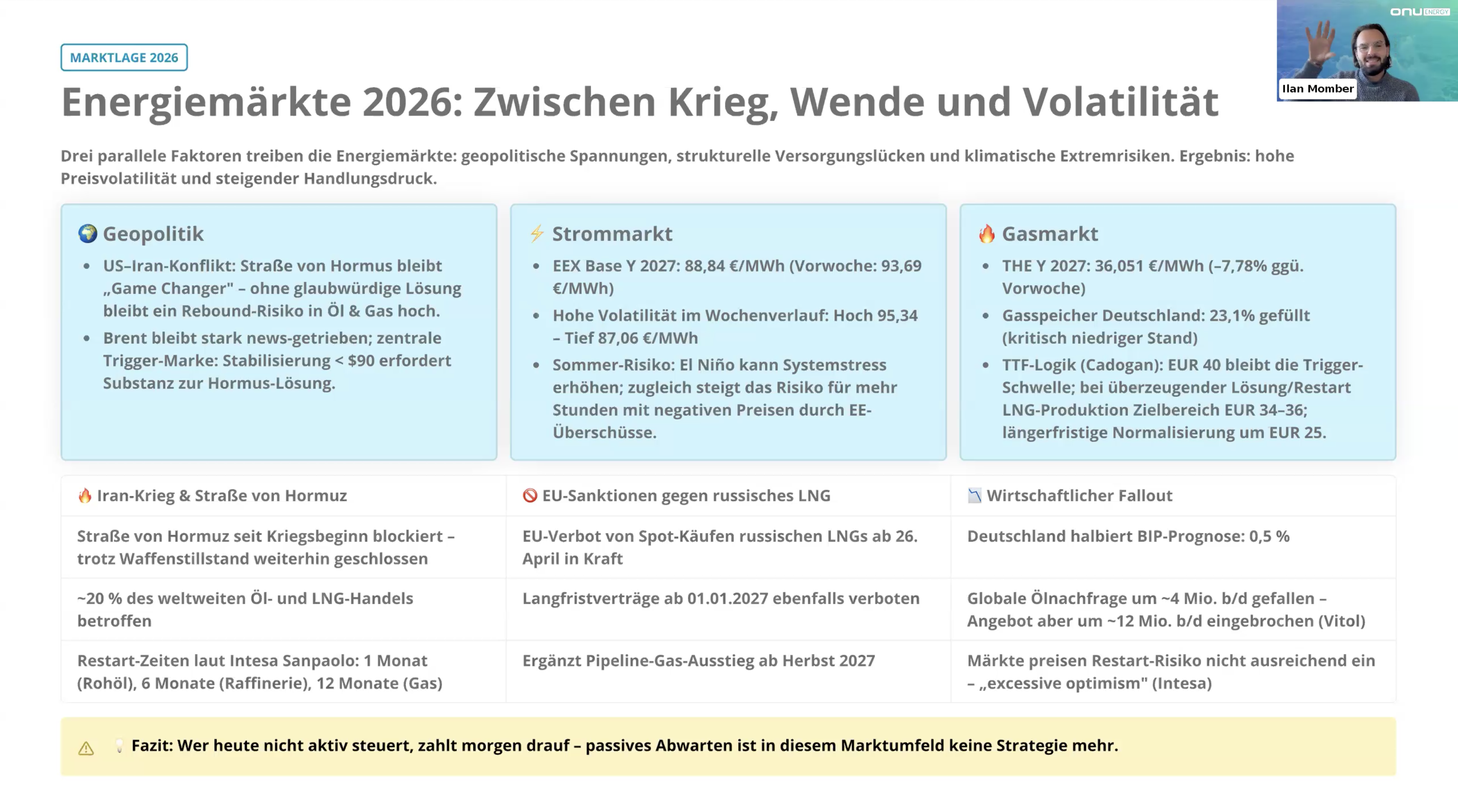
Energy markets have become structurally more volatile. If procurement strategy still rests on quarterly meetings with a supplier or a manually maintained Excel sheet, companies risk not only poor purchase prices but also losing control over one of their largest cost blocks. The issue is rarely lack of willingness—it is missing infrastructure, and that can be fixed today.
Three reasons mid-market procurement often flies blind
Most industrial firms we meet before they work with onu.energy share one trait: procurement decisions are reactive, not proactive. That rarely reflects missing expertise; it reflects three structural problems.
The first is speed. Energy markets today move faster than any weekly market summary or monthly supplier round can match. In a single morning price signals can shift fundamentally—when a geopolitical event reprices risk into forward curves or a regulatory announcement changes expectations. Anyone not working with daily current data decides on yesterday’s information.
The second is complexity. Power and gas prices are interlinked, and both depend on global factors: LNG cargoes from the Persian Gulf, Russian LNG exports, storage levels, weather scenarios, forward curves over multiple years. Tracking each factor is already demanding. Weighting them correctly and deriving a procurement decision overwhelms any manual process.
The third is missing transparency on your own position. Many energy buyers do not know in real time what share is hedged, what volumes still run on spot, and what costs that implies for the current and next year. Without that foundation every procurement call is gut feel—even when it sounds well argued.
What technical market indicators deliver—and where their limits are
Structured procurement starts by reading the market, not only watching it. Technical indicators go far beyond the raw price path.
Bollinger bands show how far the current price deviates from its moving average. Narrow bands signal a calmer market with comparatively attractive purchasing conditions. Wide bands signal high uncertainty—a hint that tranche size and timing need extra care. The volume index answers a follow-up question: does the price move reflect real trading volume, or is it noise? A rally without volume confirmation is a different signal from one backed by strong market interest. Momentum and trend indicators show whether a move is accelerating or fading.
The real value, however, lies not in any single indicator but in combining all signals and weighting them differently depending on market conditions. That is where AI adds value—not as a crystal ball but as an optimisation tool inside a structured procurement plan. onu.energy’s models are rooted in reinforcement learning and Q-learning: they learn from historical time series and produce structured recommendations—when the next purchase makes sense, at what scale, and whether waiting a few more days is better.
It is equally important to understand what AI cannot do: no model predicts geopolitical escalation. Whether a strait stays open, a pipeline is attacked, or a political decision whipsaws markets lies outside any algorithm. Protection against such tail events comes from strategy, not from AI.
Tranching beats timing—why cost averaging is the underestimated shield against price shocks
The most robust answer to volatility is not picking the perfect purchase moment; it is splitting volume over time into many small tranches. If annual demand is spread across 12–24 months in 15–20 tranches, each individual price shock hits only a fraction of total volume. That is cost averaging—and it demonstrably outperforms trying to time market lows.
The approach sounds simple but needs clear structure: a defined procurement corridor, a time horizon, an explicit risk appetite, and the discipline to stick to the plan—even when the market looks tempting. That is the difference between strategy and reaction.
In practice it can look like this: a mid-sized metals processor has already hedged 82% of the current year via a two-year strategy with a defined deviation corridor. Positions remain open for the next year, partly running on spot—with full price risk. In a volatile market that is not a comfortable starting point. The task is then not to wait for the perfect moment but to build further tranches systematically—guided by market indicators and anchored in your own strategy.
The three building blocks of structured procurement
A software-supported procurement approach does not need complexity for its own sake. It needs three layers that build on each other.
First: all relevant data in one place—consumption profiles for every site, active contracts, current market prices—consolidated automatically without manual babysitting. Only with that foundation can analysis be credible.
Second: transparency on your position. What is already hedged? What volumes are still open? How are energy costs developing versus the market, and what has the strategy delivered—in euros? Those questions should be answerable daily, not only at the next supplier meeting. As we show in our article on BESS in industrial applications, transparency about your own energy position is also the prerequisite for sensibly integrating new procurement building blocks such as batteries or PV.
Third: concrete, traceable recommendations—not a generic market picture but a structured statement: is now a good moment for the next tranche, or does current volatility argue for waiting a few more days? Every recommendation should be justified and every decision—manual or automated—fully documented. Automation does not mean loss of control. Most firms initially use AI recommendations as decision support and execute purchases manually. Others define price levels that automatically trigger tranches. Both are viable—what matters is that the process stays transparent and auditable.
Independence as the basis for neutral advice
A point often underestimated in practice: the quality of a procurement recommendation depends on whose interests sit behind it. A supplier that both delivers your kilowatt-hours and “supports” your procurement strategy has a structural conflict of interest. Its trading margin can stand in tension with your optimal purchase position.
onu.energy deliberately is not an energy supplier. We do not earn on the spread between purchase and resale. We are an independent energy services provider that delivers transparency and decision support—not the kilowatt-hour. That means your current supplier remains your supplier. We are fully agnostic about who delivers you. Precisely because we have no conflict of interest, our recommendations can be what they should be: neutral and aligned with your interest.
Anyone wanting to put energy procurement on a more structured footing will find a faster on-ramp at onu.energy than expected: load curves and existing contracts are enough to stand up a live dashboard within days. A free initial conversation gives an honest view of where the largest optimisation potential sits—tailored to your sites and consumption profile.
